Can Turnitin Detect ChatGPT? (2026)
Can Turnitin detect ChatGPT? Here is how its AI writing indicator works, why it flags human text, what detection really means, and the honest risks.
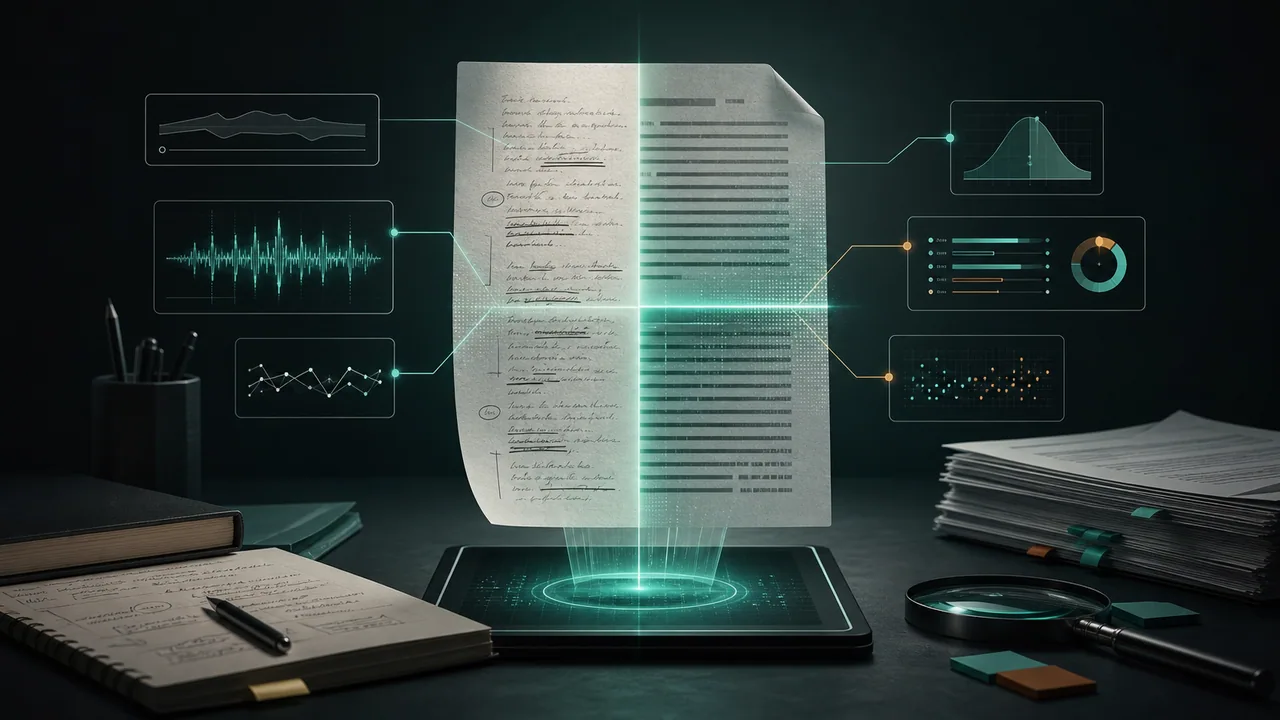
If you have pasted an essay into ChatGPT and then wondered whether your school's plagiarism checker will notice, you are asking the right question at the wrong altitude. The honest answer is: yes, Turnitin can sometimes detect ChatGPT output, but "detect" does not mean what most students assume it means. It does not scan for a watermark or match your text against a database of every AI response ever written. It makes a statistical guess.
That distinction matters, because it explains both why Turnitin catches some AI writing and why it wrongly flags plenty of writing that a human produced entirely on their own. This guide walks through how the AI writing indicator actually works, how accurate it really is, and what all of this means for you as a student who wants to stay on the right side of an academic-integrity policy.
How Turnitin's AI writing indicator works#
Turnitin's AI detection is separate from its long-standing plagiarism (similarity) checker. The similarity report compares your text against sources on the web and in its archive. The AI writing indicator does something completely different: it estimates how likely it is that a stretch of text was generated by a large language model.
Under the hood, this kind of detector leans on two statistical properties that tend to differ between machine and human prose:
- Perplexity measures how "surprised" a language model is by each word. Human writing tends to include unexpected word choices, tangents, and idiosyncrasies that raise perplexity. Model output, by design, favors the most probable next word, so it reads as smoother and more predictable, which lowers perplexity.
- Burstiness measures variation in sentence structure and length. Humans write in bursts: a long, winding sentence followed by a short one. Fragments. Then a paragraph that runs on. AI-generated text is often more uniform, with sentences of similar length and rhythm.
Turnitin trains classifiers on large samples of human and AI text, then scores your document segment by segment and reports an estimated percentage that appears AI-generated. It is pattern recognition on writing style, not a fingerprint match.
How accurate is it, really?#
Turnitin has publicly claimed high accuracy on clean, unedited AI text, and independent testing broadly agrees that it catches a large share of straight copy-paste ChatGPT output. If you generate an essay and submit it untouched, the odds of a flag are real and not worth gambling a grade on.
But accuracy is not one number. It shifts dramatically depending on the input:
- Unedited AI text: relatively high detection.
- AI text with human editing: detection drops sharply, because editing raises perplexity and burstiness toward human ranges.
- Fully human text: mostly correct, but with a stubborn false-positive rate that never reaches zero.
That last point is the one that hurts people. Turnitin has itself acknowledged that its false-positive rate, while low in aggregate, is not zero, and that the cost of a wrong accusation is high. Detection is probabilistic. It deals in likelihoods, and likelihoods are wrong some of the time.
Why Turnitin flags some human writing#
Here is the uncomfortable part. The same signals that catch AI also punish certain kinds of legitimate human writing. If your prose happens to be statistically predictable, the detector cannot tell the difference between "wrote clearly" and "wrote with a model."
Writing that tends to score higher than it should includes:
- Non-native English writing, which often uses simpler, more regular sentence structures. Multiple studies have found detectors disproportionately flag text from non-native speakers.
- Formulaic academic prose, such as lab reports or five-paragraph essays taught with rigid templates.
- Highly edited or heavily revised work, where a student has smoothed out every rough edge until the rhythm becomes uniform.
None of these are cheating. They are just writing that looks predictable to a statistical model. This is why detectors frequently disagree with each other on the same passage, a problem we cover in depth in why AI text detectors disagree. If you want to see how differently two tools can score identical text, that comparison is the clearest illustration.
What "detection" means in an academic-integrity context#
A Turnitin AI score is not a ruling. Turnitin's own guidance is explicit that the indicator is meant to inform a conversation between instructor and student, not to serve as automated proof of misconduct. In practice, most institutions require a human educator to review flagged work, consider context, and make the call.
That means the real risk is not a robot catching you. It is a human looking at a score, forming a suspicion, and asking you to account for your process. If you can show drafts, notes, and version history, a false positive is survivable. If you submitted AI text as your own, that same review is where it comes apart.
How humanizing changes the statistical signals#
Because detectors key on perplexity and burstiness, the way to make text read as more human is to move those metrics back into human territory: vary sentence length, break uniform rhythm, restore the small irregularities that models iron out. This is exactly what a Text Humanizer does. It rewrites AI output to raise burstiness and perplexity while preserving meaning.
Our Text Humanizer runs entirely in your browser, so your draft is never uploaded to a server, and it lets you dial the strength of the rewrite. Lighter passes preserve more of your original phrasing; heavier passes restructure more aggressively.
Be clear-eyed about the limits, though. Humanizing shifts the statistical odds; it does not guarantee a clean result, and it cannot make prohibited use permitted. Detectors evolve, new signals get added, and any tool that promises 100% evasion is lying to you. The legitimate use case is polishing your own drafting and reducing false positives on writing you actually did, not laundering academic dishonesty.
The honest bottom line#
Can Turnitin detect ChatGPT? Yes, imperfectly, and increasingly well on lazy copy-paste jobs. It works by measuring how statistically predictable your writing is, not by matching a database, which is why it both catches real AI text and mislabels real human text. Treat any score as a probability, not a verdict.
The genuinely safe path is the boring one: understand your institution's policy, do the thinking yourself, and keep evidence of your process. If you are curious how Turnitin stacks up against other tools, see our breakdown of Originality vs Turnitin. And if you want to check writing before you submit it, tools like an AI Image Detector show how the same probabilistic scoring plays out across media, a useful reminder that detection is always a guess, never a certainty.
Review method, sources and limits
- Reviewed by
- Tim Geithner · Founder and technical reviewer
- Last reviewed
- July 1, 2026
We compare current primary documentation with the implemented browser data flow and, where stated in the article, repeatable hands-on observations. A detector score is not proof of authorship or provenance. No controlled benchmark is claimed unless the article names its sample, tested version, date and method; third-party products and policies can change.
Primary references
SynthGuard.net — privacy-first tools
Humanize AI media locally and choose a clearly disclosed text mode.
Images, video and detector scans stay on your device. Light-mode text is local; deeper text modes use the protected inference route. No detector outcome is guaranteed.
All third-party names, logos and trademarks (e.g. Hive, Optic, Sensity, Sightengine, Illuminarty, GPTZero, Instagram, TikTok, OnlyFans, Fanvue, SynthID, C2PA) are the property of their respective owners. SynthGuard is an independent service and is not affiliated with, endorsed by, sponsored by, or partnered with any of these companies or platforms. Detector and platform names are used solely for descriptive comparison under § 6 UWG / Art. 4 Directive 2006/114/EC.
Frequently asked questions
Keep reading
Falsely Accused of Using AI? What to Do
You wrote it yourself. A tool says you did not. That is a uniquely infuriating situation, and the instinct it produces — a long, emotional email defending your integrity — is almost always the wrong…

Originality.ai vs Turnitin (2026)
If you have ever submitted a piece of writing and worried about an AI flag, you are dealing with one of two systems. Turnitin dominates higher education — its AI indicator now ships in the standard s…
Why AI Text Detectors Disagree (2026)
AI text detectors are everywhere — in classrooms, in publishing workflows, in HR screening. They are also, frequently, wrong. The same paragraph submitted to GPTZero, Originality.ai, and Turnitin wil…