Can Copyleaks & Grammarly Detect ChatGPT?
Can Copyleaks or Grammarly detect ChatGPT? How each AI detector actually works, why vendor accuracy claims differ from reality, and the false-positive risk.
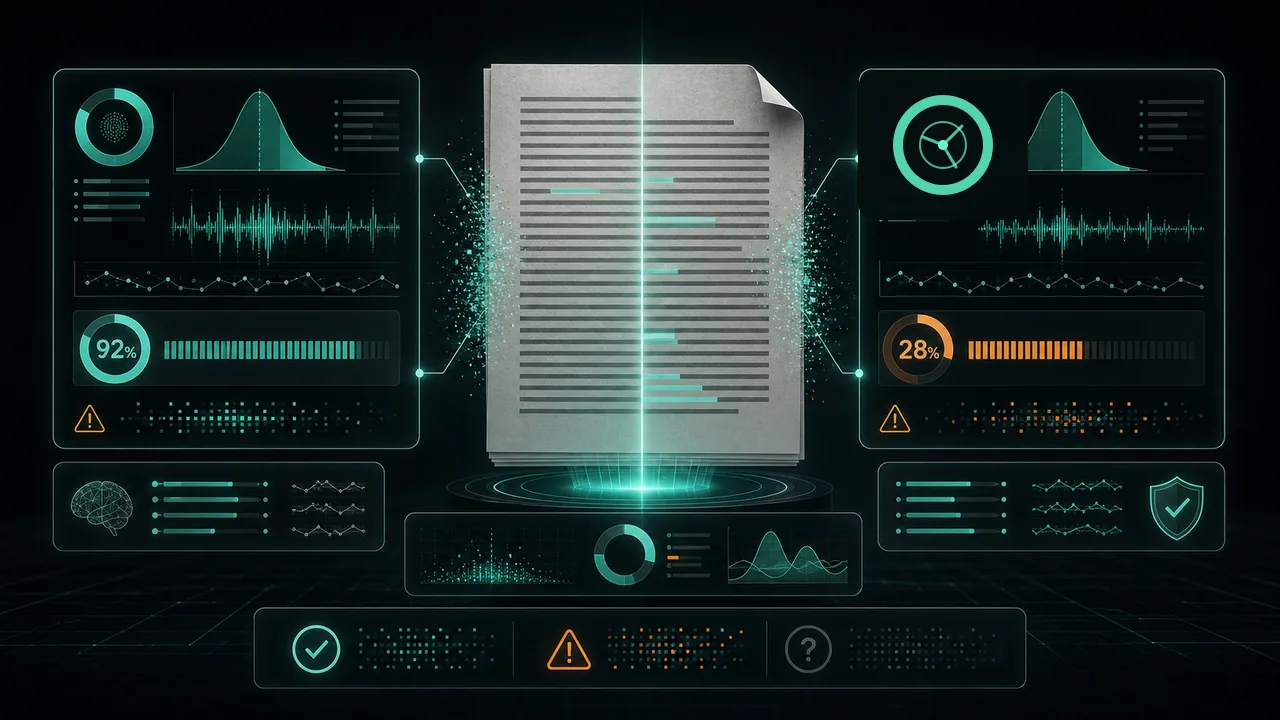
You pasted a paragraph you wrote into Copyleaks, and it came back flagged as "AI." Then you tried Grammarly's authorship report, and it gave you a different number. Now you are staring at two scores, wondering which one to believe, and whether either of them can actually tell that you used ChatGPT.
The honest answer is that both tools are estimating, just with different math and different goals. Copyleaks and Grammarly are not the same kind of product, they were not built to do the same job, and understanding that difference is the fastest way to stop panicking over a single red number.
Copyleaks: a dedicated detector built for enforcement#
Copyleaks is a purpose-built AI and plagiarism detector, marketed heavily to educators and enterprises. When you run text through it, you get an AI-likelihood readout — some percentage or classification suggesting how much of the document looks machine-generated.
Under the hood, it works like most modern text detectors: a trained classifier that scores linguistic features rather than searching for a fingerprint. It looks at statistical patterns in word choice and sentence construction, the kind of signals often described as perplexity (how "surprised" a language model is by the next word) and burstiness (how much sentence length and rhythm vary). Human writing tends to be uneven and unpredictable. A lot of raw model output is smoother and more uniform, and that smoothness is what a classifier learns to flag.
The vendor claims high accuracy for this approach. That claim is worth taking seriously, but not at face value. Independent testing of AI text detectors — Copyleaks included — repeatedly surfaces the same weakness: false positives. Text that is formulaic, tightly edited, or written by non-native English speakers tends to score as more "AI-like," because that writing is often more uniform and constrained, which is exactly the signal the classifier keys on. A confident percentage is still a probability estimate, not a confession.
Grammarly: a writing assistant that added a detector#
Grammarly comes at this from a different direction. It started as a writing assistant — grammar, tone, clarity — and later added an AI-writing detection and authorship report. That feature estimates how much of a document appears AI-generated and, in some contexts, how much was typed, pasted, or generated.
The important thing to understand: this is not built like a forensic detector, and it is not positioned as an institutional gatekeeper the way Copyleaks or Turnitin are. Grammarly's framing is self-check and transparency — a way for a writer to see how their own document might read to a detector, or to demonstrate their own process. It is aimed at the person doing the writing, not at an authority trying to catch them.
That distinction matters because people conflate the two. A Grammarly authorship number is not a verdict handed down by an examiner. It is a signal, generated by a tool whose primary job is helping you write, that estimates the odds a passage looks machine-written. Useful for a gut check. Not something to lose sleep over.
How they compare to Turnitin, GPTZero, and Originality#
Step back and the whole category starts to look similar. Turnitin added AI detection onto its plagiarism infrastructure and pushed it into universities — we go deeper on that in can Turnitin detect ChatGPT. GPTZero popularized the perplexity-and-burstiness framing for a general audience. Originality.ai targets publishers and SEO teams, and we compare its approach head-to-head in Originality vs Turnitin.
Different logos, but mechanically they are cousins: each trains a classifier on examples of human and machine text, then scores new writing against what it learned. The differences are in the training data, the exact features, and where each vendor sets its threshold for calling something "AI."
Which is precisely why they disagree. Run one passage through five detectors and you can easily get five different answers — one flags it, one clears it, three land somewhere in the murky middle. That is not a malfunction. Each tool measures a slightly different signal against a slightly different bar, so they carve up the same text differently. We break down the mechanics of that disagreement in why AI text detectors disagree, and it is the single most important thing to internalize: there is no ground-truth oracle. There are only competing estimates.
The honest takeaway#
Here is what actually holds up. Any single AI-detection score — from Copyleaks, Grammarly, or anyone else — is probabilistic evidence, not proof. Vendors optimize for confident-sounding accuracy numbers; independent testing keeps finding false positives that fall hardest on the people least able to defend themselves. And because these detectors read statistical patterns rather than intent, the signal they key on shifts the moment text is genuinely revised.
That last point is the practical one. Detectors flag uniformity — flat rhythm, predictable word choice, the tidy sameness of a lot of raw model output. Writing that carries a real human hand tends to be burstier and less even, and it reads that way to a classifier too. If you have drafted something with AI assistance and it comes out sounding stiff, the fix is not a trick — it is doing the editing that makes it genuinely yours: varying sentence length, cutting filler, letting your own phrasing back in.
That is the legitimate use case, and the only one we endorse: your own writing, that you want to sound like you actually wrote it, rather than like it came off an assembly line. SynthGuard's text humanizer runs entirely client-side in your browser — nothing is uploaded, no login — and rewrites toward more natural rhythm and variation. It is not a magic cloak, and no honest tool is. If you want the deeper mechanics of what does and does not move a detector's needle, we lay it out in how to bypass GPTZero in 2026.
None of this means detection is useless. It means the score is a starting point for a conversation, not the end of one. Copyleaks can flag ChatGPT-like text, Grammarly can estimate it, and both will sometimes be wrong in ways that matter. Treat the number as evidence, weigh it against everything else you know, and keep your standard for calling something "AI" as high as the stakes demand.
Review method, sources and limits
- Reviewed by
- Tim Geithner · Founder and technical reviewer
- Last reviewed
- July 1, 2026
We compare current primary documentation with the implemented browser data flow and, where stated in the article, repeatable hands-on observations. A detector score is not proof of authorship or provenance. No controlled benchmark is claimed unless the article names its sample, tested version, date and method; third-party products and policies can change.
Primary references
SynthGuard.net — privacy-first tools
Humanize AI media locally and choose a clearly disclosed text mode.
Images, video and detector scans stay on your device. Light-mode text is local; deeper text modes use the protected inference route. No detector outcome is guaranteed.
All third-party names, logos and trademarks (e.g. Hive, Optic, Sensity, Sightengine, Illuminarty, GPTZero, Instagram, TikTok, OnlyFans, Fanvue, SynthID, C2PA) are the property of their respective owners. SynthGuard is an independent service and is not affiliated with, endorsed by, sponsored by, or partnered with any of these companies or platforms. Detector and platform names are used solely for descriptive comparison under § 6 UWG / Art. 4 Directive 2006/114/EC.
Frequently asked questions
Glossary terms in this article
Keep reading
Can Turnitin Detect ChatGPT? (2026)
If you have pasted an essay into ChatGPT and then wondered whether your school's plagiarism checker will notice, you are asking the right question at the wrong altitude. The honest answer is: yes, Tu…
Why AI Text Detectors Disagree (2026)
AI text detectors are everywhere — in classrooms, in publishing workflows, in HR screening. They are also, frequently, wrong. The same paragraph submitted to GPTZero, Originality.ai, and Turnitin wil…

Originality.ai vs Turnitin (2026)
If you have ever submitted a piece of writing and worried about an AI flag, you are dealing with one of two systems. Turnitin dominates higher education — its AI indicator now ships in the standard s…