How Do I Know If a Photo Is AI-Generated?
How do I know if a photo is AI-generated? Learn the visual tells, the forensic signals detectors check, and how to run a free browser-based check in 2026.
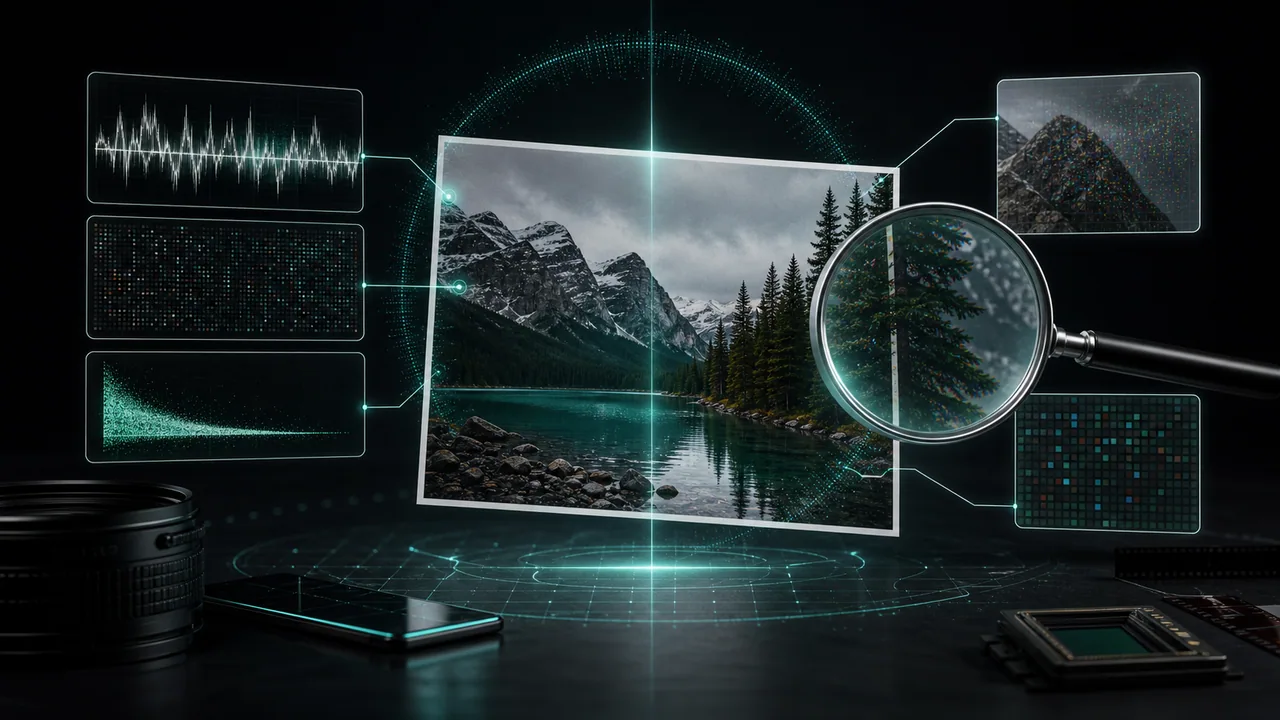
You saw a striking image online and something feels off. Maybe the lighting is too perfect, maybe a friend swears it is real, and now you are stuck asking the question millions of people type into search every day: how do I know if a photo is AI-generated? The honest answer is that there is no single trick that settles it, but there is a practical process that gets you to a confident guess.
This guide walks through the visual tells most people rely on, explains why those tells are fading in 2026, and then goes one level deeper into the forensic signals that automated tools actually measure. By the end you will know how to run a real check yourself and, just as importantly, how to read the result without fooling yourself.
The visual tells you can spot with your own eyes#
For a couple of years, a handful of giveaways worked surprisingly well. They are still worth checking first because they cost nothing and catch a lot of lazy fakes.
- Hands and fingers. Extra fingers, fused knuckles, or thumbs bending the wrong way remain a classic failure mode. Look closely at any hand near the edge of the frame.
- Text and logos. Signs, book spines, brand names, and license plates often melt into nonsense letters. Generators struggle to render coherent typography.
- Backgrounds. Crowds, railings, window grids, and repeating patterns tend to warp, merge, or dissolve where the model ran out of attention.
- Reflections and shadows. Mirrors, sunglasses, and puddles frequently show reflections that do not match the scene, and shadows that fall in impossible directions.
- Over-smooth skin. A waxy, poreless, airbrushed quality, especially combined with flawless symmetry, is a strong hint of a synthetic face.
Why those tells are getting unreliable#
Here is the uncomfortable part. Every giveaway listed above is being engineered away. The 2026 generation of models renders hands correctly far more often, produces legible text, and adds convincing skin texture on purpose. Some tools even inject sensor noise and film grain to defeat casual inspection.
That means two things. First, a clean image is no longer evidence of a real photo, because the absence of obvious flaws proves nothing. Second, the presence of a flaw is no longer conclusive either, since real cameras also produce motion blur, compression artifacts, and odd reflections. Relying only on your eyes now produces confident wrong answers in both directions, which is exactly why a measurement-based check matters.
The forensic signals a detector actually checks#
When you cannot trust the surface, you look underneath it. Automated detectors ignore the aesthetics and instead measure statistical properties of the pixels themselves. These are the signals our AI Image Detector weighs, and they are far harder to fake than a well-drawn hand.
- Noise fingerprint. Real camera sensors leave a subtle, structured noise pattern called PRNU. AI images either lack it or carry a suspiciously uniform noise that does not behave like a physical sensor.
- JPEG grid consistency. Every JPEG is compressed in 8 by 8 pixel blocks. Genuine photos share one consistent compression history, while generated or edited images often show mismatched or doubled grids.
- Frequency energy (FFT). Transforming the image into the frequency domain exposes how energy is distributed across fine and coarse detail. Diffusion models leave characteristic energy signatures that differ from optical capture.
- Color and channel statistics. Entropy across color channels, chroma subsampling behavior, and cross-channel correlation tend to fall outside the range of a real camera pipeline.
- EXIF and metadata. Camera make, model, lens, exposure, and timestamps can support authenticity, though this is the weakest signal of all, for reasons covered below.
No single one of these is decisive. A detector combines them into a weighted 0 to 100 score, so a fake that happens to fool one signal usually trips another. That layered approach is what makes an automated read more reliable than any one tell.
Why metadata is a weak, but still useful, clue#
Metadata feels like it should be the smoking gun, and occasionally it is, but treat it with heavy skepticism. EXIF data is trivially easy to fake, and it is even easier to strip. Every time you screenshot an image, upload it to a social platform, or forward it through a messaging app, the original metadata is usually wiped. So a photo with no EXIF is completely normal and tells you almost nothing.
The reverse is more interesting. If an image carries a coherent set of camera fields, a plausible lens, a sensible exposure triangle, and a timestamp that matches the apparent lighting, that is mild supporting evidence for a real capture. But because those fields can be forged, and because humanizer tools deliberately generate realistic fake EXIF, you should never lean on metadata alone. If you want to see what a file is actually carrying, or scrub it from your own photos before sharing, a quick pass through an EXIF remover shows you exactly which fields are present.
How to actually run a check#
Putting it together, here is a workflow that respects both your eyes and the math.
- Look first. Do a quick visual scan for the classic tells. If you spot melted text or a seven-fingered hand, you may already have your answer.
- Check the source. Where did the image come from, who posted it, and does a reverse image search show an original with a credible provenance? Context is often more decisive than any pixel analysis.
- Run a forensic scan. Upload the file to a detector that measures the signals above and returns a score. Because everything runs in your browser, the image never leaves your device.
- Weigh the result. Read the score as a probability, not a verdict, and combine it with what the source and your eyes told you.
If you want to understand what happens between upload and score in more depth, our companion piece on how AI image detectors work breaks down each signal. And if you are curious why so many tools claim to defeat detection yet fail, why most AI humanizers fail explains the cat-and-mouse dynamic driving all of this.
The honest bottom line#
No method here is conclusive, and anyone who promises you a definitive yes or no is overselling. Detection is a probability game played against models that improve every month. A high score plus melted background text plus a sketchy source is a strong case; a borderline score on a clean image from a trusted outlet is not something to panic over.
Use your eyes for the first pass, use context to anchor your judgment, and use a forensic AI Image Detector to add a measured signal that pure looking cannot provide. Treat the whole thing as building a case rather than flipping a switch, and you will be right far more often than the people relying on any single trick. If you work on the other side of this problem and need your own legitimate renders to read as natural, the same forensic understanding powers our Photo Humanizer and Video Humanizer tools.
Review method, sources and limits
- Reviewed by
- Tim Geithner · Founder and technical reviewer
- Last reviewed
- July 1, 2026
We compare current primary documentation with the implemented browser data flow and, where stated in the article, repeatable hands-on observations. A detector score is not proof of authorship or provenance. No controlled benchmark is claimed unless the article names its sample, tested version, date and method; third-party products and policies can change.
Primary references
SynthGuard.net — privacy-first tools
Humanize AI media locally and choose a clearly disclosed text mode.
Images, video and detector scans stay on your device. Light-mode text is local; deeper text modes use the protected inference route. No detector outcome is guaranteed.
All third-party names, logos and trademarks (e.g. Hive, Optic, Sensity, Sightengine, Illuminarty, GPTZero, Instagram, TikTok, OnlyFans, Fanvue, SynthID, C2PA) are the property of their respective owners. SynthGuard is an independent service and is not affiliated with, endorsed by, sponsored by, or partnered with any of these companies or platforms. Detector and platform names are used solely for descriptive comparison under § 6 UWG / Art. 4 Directive 2006/114/EC.
Frequently asked questions
Keep reading
Which AI Images Are Easiest to Detect?
"Can detectors tell?" is the wrong question. Two images from two generators, of the same subject, at the same resolution, can sit at opposite ends of the detectability scale — and most of the gap has…
How AI Image Detectors Actually Work
AI image detectors look magical from the outside — drop an image, get a percentage, ship the verdict. Inside, they are an assembly of brittle statistical signals stacked on top of each other, each ca…
Why Most AI Humanizers Fail
Search for "AI humanizer" and you get hundreds of tools, almost all of them promising the same thing: paste your AI image, video, or text, get back something that sails past every detector. Most of t…